

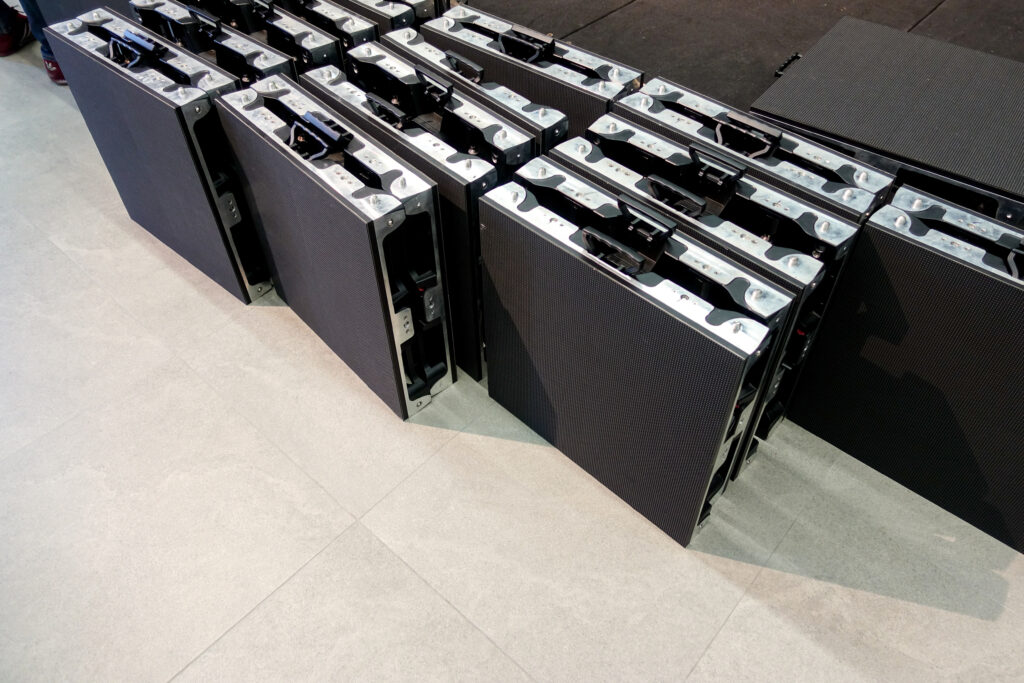
If space is limited at the video wall’s position, the physical depth of the solution may be a deciding issue. Most LCD panels and LED tiles are rather thin. Generally with a depth of less than 4″ or 100mm. They can be installed with as little as 4-8″ of space front to back, including the mount. These may be the best alternative if space is limited.
Regardless of the screen width, a standard LED screen is less than 100mm thick. But, a 4m rear projection system may need 4-5m depth. This allows for adaptable installations in unique locations.
LCD panels and LED tiles are very simple to install due to their shallow profile depth and smart design. The potential to put LED tiles along a curve or construct any size or form of display is an intriguing possibility. Best-in-class LCD and LED walls are sold with direct mount systems. Thus allowing them to be put on flat walls without third-party solutions. This saves money and simplifies installation.
Following barrier-free guidelines
Choose a low-profile and narrow-depth(thin) video wall. Ensure that your display conforms to your country’s criteria. These criteria are for safer, accessible, barrier-free environments and follows universal design principles. According to the Canadian Standards Association (CSA) and the Americans with Disabilities Act (ADA), exhibits in Canada and the United States must be no more than 4″ or 100mm away from the wall to be deemed barrier-free. LCD panels and LED tiles work effectively in areas with specific requirements.
How to reduce the thickness of a video wall
LED (Light Emitting Diode) technology has made remarkable breakthroughs in recent years. LEDs with emission efficiencies greater than fluorescent tubes have been produced. They are being used in the field of light fixtures. It is also common knowledge that LED light sources significantly impact LCDs’ increased thinness.
Even the smallest CCFL has a diameter of 1.8mm in most circumstances. Because two must be used side by side to provide high definition, the Light Guide Plate must be more than 4mm thick.
On the other hand, some manufacturers employ an LED that is just 0.8mm thick, resulting in a 1mm thick Light Guide Plate. Compared to standard CCFL B/L, they achieved a 15% reduction in thickness and a 17% reduction in mass by employing LED.
This module’s backlight is made of 0.8mm thick LEDs and a Light Guide Plate of the same thickness. And by employing the downward prism approach for the Light Guide Plate. It is able to achieve the same performance with just two optical sheets instead of four. This it achieves a 0.2mm thin profile. They were able to achieve a thickness of 3.9mm (excluding the signal layer). They did this by reducing:
the thickness of the Light Guide Plate
the number of optical materials used
the thickness of chassis materials
the thickness of the TFT glass substrate.
This represents a 46% reduction in thickness and a 47% reduction in mass when compared to conventional CCFL B/L.
The difference in Video Wall Thickness Between LED Video walls and QLED Video Walls
LED displays are relatively thin and light. But they are thicker and heavier than their OLED counterparts. This is due to the increased size of the LEDs that provide the display’s illumination.
FAQs
Who makes the thinnest video wall?
Panasonic Connect makes the thinnest video wall. Their VF2 is the thinnest video wall display in the world. It has a bezel width of 0.88mm. Ideal for use in digital signs, broadcast studios, and control rooms, razor-thin, narrow frames make enormous, captivating video walls possible.
How much space should I leave behind a video wall?
You need to leave space for ventilation and installation structures. This will not be much as there are ultra thing videos nowadays. These video walls do not occupy much space in terms of depth. They can be installed with as little as 4-8″ of space front to back, including the mount.
Does the thickness of a video affect its functions?
As technologies advance, the size of transmitters, chips and transformers has significantly reduced. This enables video wall manufacturers to make thin video walls without any negative effect on the performance of the display solution.